
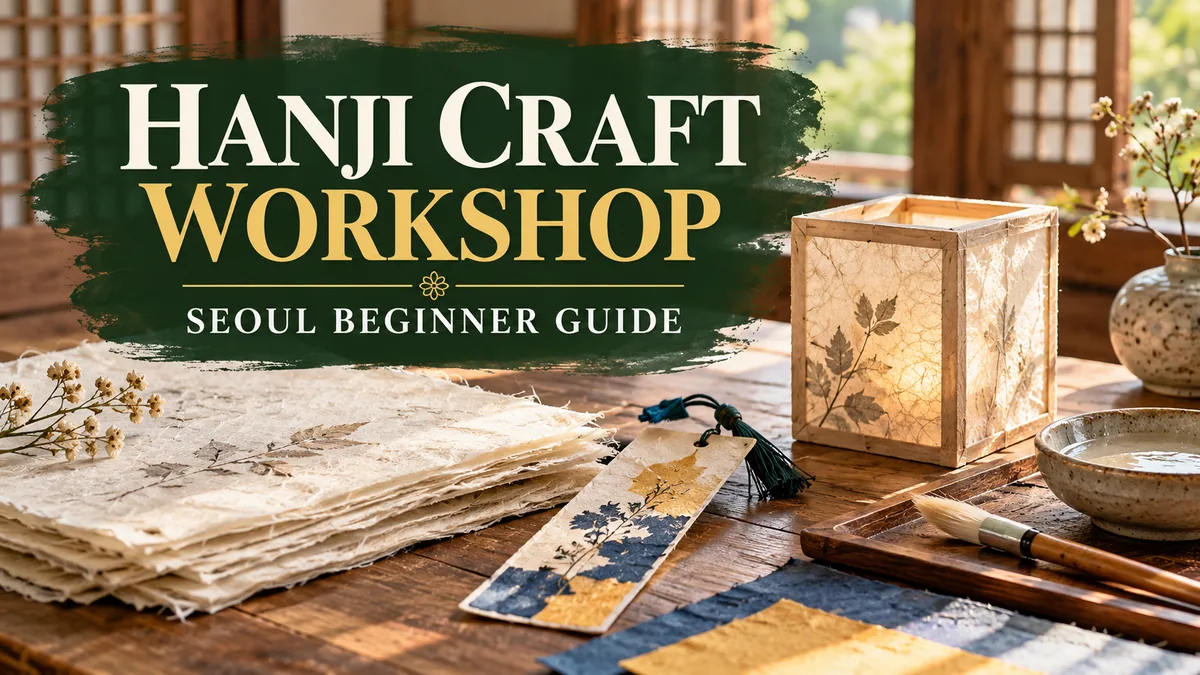
Which Korean hanji craft workshop should a first-time visitor book in Seoul? Start by deciding whether you want to make a sheet of traditional paper or create a bookmark, cover or small object using paper that has already been made. Those are different experiences, even when both are advertised as “hanji workshops.” Before paying, verify the activity, hands-on minutes, materials, instructor language and whether your finished piece can travel home safely.
Important venue status (checked October 30, 2026): KCDF’s official Hanji House website states that Hanji House is temporarily closed during relocation, with reopening planned for March 2027. Do not travel to the former Hanji House location expecting an open museum or a bookable class. Its archived classes below are used only to explain workshop formats. Find a different operator with a current program announcement if you want a class now.
This independent guide compares published information from the Korea Craft & Design Foundation (KCDF), the KCDF-operated Hanji House, and the Korea Tourism Organization (KTO). It is a researched decision guide, not a review of a workshop we attended. Information was reviewed on October 30, 2026; live sessions and fees still require organizer confirmation.
The 30-second decision: making paper or making with paper?
| You want to… | Look for this activity | Verify before booking |
|---|---|---|
| Understand the original process | Papermaking from fibers or pulp | Will you actually form a sheet with a screen, or only watch a demonstration? |
| Make a small gift | Bookmark, book-cover or decorative-item class using prepared hanji | Are the hanji sheets, tools and finishing supplies included? |
| Explore the craft without committing to a class | Hanji exhibitions, archives or guided interpretation | Does the visit include any participatory activity, and does it require a reservation? |
| Learn a more complex technique | Structured multi-step craft or artisan-led session | Do beginners qualify, and how much independent making time is provided? |
The distinction matters because hanji refers to Korea’s traditional paper and its making traditions, whereas a souvenir craft may start with finished sheets. The KCDF describes hanji as a historical material now used in contemporary objects and education. Its 2026 exhibition explanation describes paper fibers crossing during the traditional sheet-forming process. A finished-paper craft can still be culturally meaningful; it simply teaches a different part of the tradition.
What official Seoul sources actually confirm
1. Hanji House: a place to learn about the material
Hanji House (한지가헌) is a KCDF-operated cultural project associated with 31-9 Bukchon-ro, Jongno-gu, Seoul, where it previously documented exhibitions, traditional paper archives and hands-on activities. It is not presently open for visitors: the operator’s current website lists temporary closure for relocation and a planned March 2027 reopening. Older KTO and KCDF attraction pages may still display normal opening hours, which must not override the updated closure announcement. Use this venue as a cultural reference, not a current October 2026 booking suggestion.
2. A dated bookmark/book-cover class is evidence of a format, not live inventory
KCDF’s bookmark and book-cover workshop notice describes using handmade hanji from traditional Korean workshops, feeling its texture and making a usable object. Its published program period ended May 17, 2026. As of this article’s review, that page is an example of a past offering, not evidence that the same workshop can be booked in late October 2026. The notice also says participants making a book cover should bring their own book; this is a useful example of why an inclusion checklist matters.
3. KTO lists other types of Seoul hanji activities
KTO’s Seoul Folk Flea Market Traditional Arts & Crafts Studio listing describes hanji-based items such as a plate, hand mirror, photo frame and lampshade. That demonstrates the range of object-making experiences. Published attraction listings may outlast program changes: verify the studio’s current operation, actual item, language and registration process through the responsible operator before committing to a visit.
A five-check booking test designed for first-time visitors
- 1. Activity identity: Ask “Will we form hanji from fibers, decorate finished hanji, or just watch?” If the answer is vague, request a short outline of the steps.
- 2. Hands-on time: Ask how many minutes you spend making something yourself, not simply the door-to-door duration. A 90-minute tour may include significant demonstration time.
- 3. Total cost: Confirm a price for each participant, materials, finishing, packaging, any deposit, and refund rules. Do not assume a tourist listing’s old “free” label applies to the specific class.
- 4. Participation needs: Check instructor language, age guidance, accessibility, seated versus standing work, and whether scissors, adhesive, blades or wet papermaking tools will be used.
- 5. Take-home plan: Ask whether the work is dry and ready to carry, whether a protective sleeve is included, and what happens if a session is canceled or the artwork needs time to cure.
Original go/no-go test: three different kinds of hanji evidence
Don’t compare invented class prices when the published venues have different operating status. We instead cross-checked the dated primary evidence below. A closure notice, an expired class announcement and a general tourism directory answer three separate questions; none on its own establishes a bookable class for your visit. This is our source-status analysis, not an account of a reservation.
| Evidence you encounter | What it actually verifies | Booking verdict on October 31, 2026 |
|---|---|---|
| KCDF’s April 27, 2026 Hanji House closure notice | The Bukchon venue closed after May 17, 2026 for relocation; the operator’s site plans reopening in March 2027 | Do not travel there to attend a current class. Recheck the operator for any future reopening announcement. |
| KCDF’s dated bookmark and book-cover program, which ended May 17, 2026 | A previous class used prepared handmade hanji for object-making; it does not establish current enrollment | Historical example only. Look for a newer, explicitly dated notice. |
| KTO’s general Seoul Folk Flea Market craft-studio directory | Possible hanji-based objects and the type of experience described by a tourism service | Operator verification required. Ask whether a specific current class exists and whether you form paper or decorate it. |
A practical three-step decision: (1) Reject a currently closed venue as a visit destination, even if old tourism pages still show opening hours. (2) Treat an ended 2026 session as evidence of what was once taught, not an offer. (3) For any alternative provider, request a current dated booking confirmation that names your actual task. If your goal is papermaking, ask whether you handle wet paper-mulberry fibers and a sheet-forming screen (oebal); if the organizer supplies finished sheets to fold or decorate, choose it as a hanji object-making class rather than a paper-production lesson. The KCDF’s 2026 exhibition on the structure of hanji documents the screen and fiber-interlacing process, but was not itself a confirmed papermaking class. The specific tools, drying arrangements and fees still need operator confirmation.
What you might learn about hanji — without overstating it
The KCDF’s hanji projects explain that traditional Korean paper has many uses, from artistic expression to practical objects. The Hanji House exhibition material describes an oebal (a papermaking screen) and a technique in which paper-mulberry fibers interlock as water flows during sheet formation. A visitor who only folds or decorates purchased hanji will not necessarily learn that full manufacturing sequence. Ask whether the class offers explanation of the paper’s origin, fibers, textures and cultural uses—not merely a photo opportunity.
Useful Korean terms: 한지 (hanji), traditional Korean paper; 한지공예 (hanji gongye), hanji craft; 체험 (cheheom), hands-on experience; 재료비 포함 (jaeryobi poham), materials included; 예약 (yeyak), reservation. These help you read a listing, but staff or machine translation should confirm any contract or safety-critical detail.
A realistic first-visit sequence
- Before leaving: Open the organizer’s latest program notice and check date, registration method and exact address. Do not assume the schedule in a static tourism directory is current.
- At arrival: Show your reservation confirmation and ask which parts are demonstration and which you will do yourself.
- During the class: Handle paper and tools as instructed. Wet paper, dyes, adhesives and sharp craft tools may require precautions that vary by provider.
- Before finishing: Confirm drying or curing, packaging, photography consent and whether you may take the object home the same day.
- Afterwards: If curious about different craft traditions, compare jasu embroidery and dancheong pattern painting. These use different materials and should not be conflated.
Three common mistakes, and the safer alternative
| Mistake | Why it matters | Better next action |
|---|---|---|
| Treating any “hanji experience” as papermaking | Decorating a ready-made sheet is not the same as making paper | Ask for the first and last steps of the actual lesson |
| Using a dated event page as live availability | A past workshop may not be running or may have changed price | Check the organizer’s current schedule and booking confirmation |
| Booking by lowest headline price alone | Materials, guided time or drying may vary | Compare the complete included activity and finishing arrangements |
Frequently asked questions
Can a complete beginner join a hanji craft workshop?
Often, beginner-oriented programs exist, but each organizer sets its own level, ages and tool requirements. Look for an explicit beginner label and confirm the activity in English or in language you can understand.
Is Hanji House offering a book-cover session today?
No: the example KCDF book-cover course ended May 17, 2026, and the Hanji House operator currently reports a temporary closure for relocation, with a planned reopening in March 2027. Do not assume a booking slot exists. Check the operator’s official closure and reopening notices; choose another presently operating provider if you want an October 2026 activity.
Will I take home real handmade hanji?
Not necessarily. Some experiences use finished hanji made by traditional workshops; others teach papermaking, and others may involve demonstration only. Ask where the materials come from and exactly what you keep.
What if my family member cannot stand for long or handle scissors?
Ask in advance whether seating, accessible entry and alternative tools are available. Do not infer accessibility from promotional photographs. If a class uses blades, wet materials or adhesive, request the organizer’s actual safety guidance.
Official sources and review limits
- KCDF — Hanji (Korean Paper) Projects: context about traditional paper and hands-on education.
- KCDF — Hanji House official site: temporary closure and planned March 2027 reopening; supersedes stale visitor hours shown elsewhere.
- KCDF — Hanji Bookmark / Bookcover Workshop notice: historical example, ending May 17, 2026.
- Korea Tourism Organization — Hanji House: independent attraction summary, not a live class inventory.
- Korea Tourism Organization — Seoul Folk Flea Market studio: examples of hanji object-making.
Editorial note, reviewed October 30, 2026: We compared official pages; we did not attend a class, verify an individual 2026-10-30 booking slot, or test any workshop’s foreign-card checkout. No prices in the illustrative comparison are venue quotes. Hours, fees, programs, languages and accessibility can change. Featured image is AI-generated and does not depict a verified venue or firsthand visit. For the complete cultural experience library, start here; for corrections, use Contact.