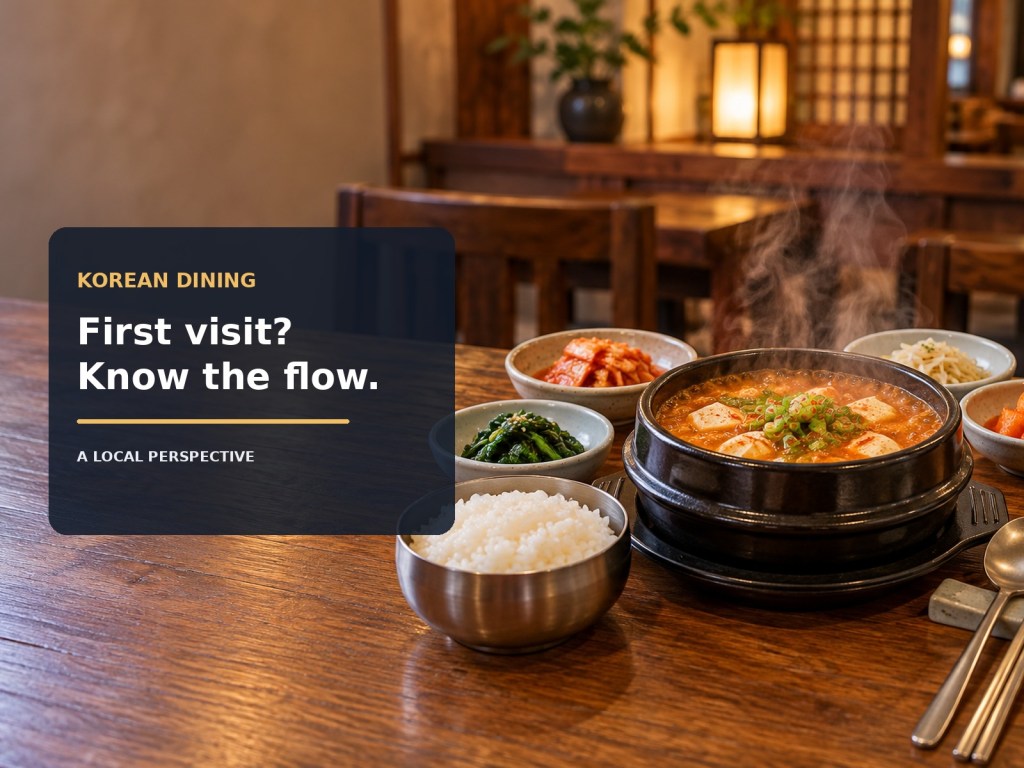
First time at a Korean restaurant? Check the price and serving size before ordering, follow the restaurant’s ordering system, and ask staff about any ingredient that affects your safety. A typical visit may include banchan (small side dishes), self-service water or utensils, and payment at either the table or a counter. The details vary by restaurant, so use the signs and ask when something is unclear.
Why this guide: K-Culture in Korea helps English-speaking visitors understand how to experience Korean culture and everyday life through practical local context. I’m a Korean writer. For this restaurant guide, I checked the Korea Tourism Organization’s visitor information; I did not treat one venue’s routine as a rule for every restaurant.
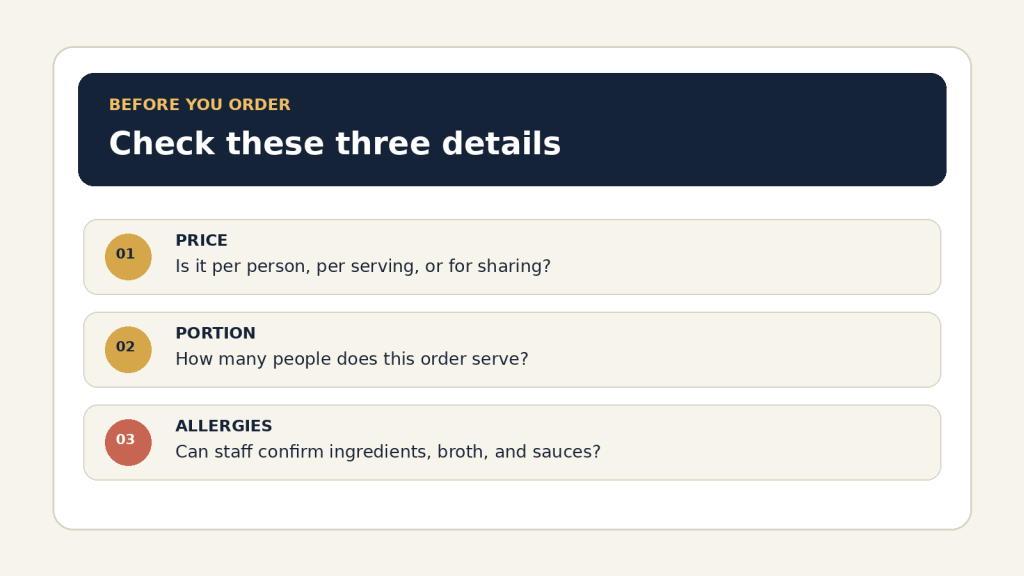
Before you order: check the price, portion, and ingredients
Look at the menu and check what each price covers. It may be listed per person, per serving, or for a dish to share. Barbecue, hot pot, and some specialty dishes can have a minimum order or serving size. If the menu does not make this clear, ask before ordering—especially if you are eating alone or want to avoid ordering more food than you need.
If you have an allergy or strict dietary need, name the specific ingredient and ask whether it is in the dish, broth, sauce, or seasoning. “No meat” may not answer whether a broth contains seafood, for example. Ask the staff to confirm with the kitchen. If they cannot verify an ingredient that matters for your safety, choose another dish or restaurant rather than relying on a guess.
How to enter, order, and ask for help
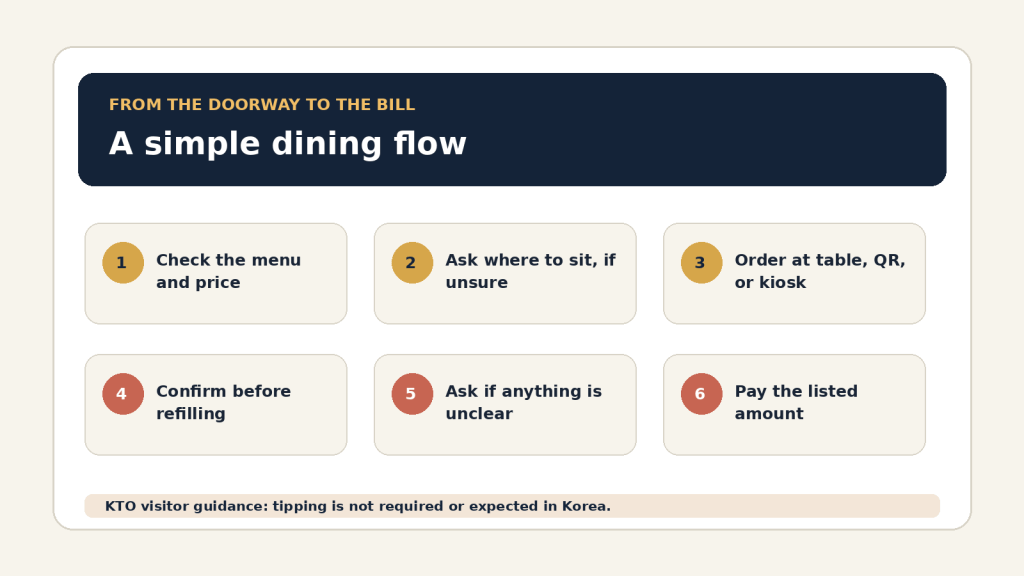
There is no single system. A staff member may seat you and take your order, or you may order from a table tablet, QR menu, or kiosk. The Korea Tourism Organization notes that self-service water and side-dish stations and unmanned ordering machines are common enough for visitors to encounter. Look for signs first. If a kiosk offers English, choose that option before adding items; check the quantity and total before submitting.
If you are unsure whether to wait, choose a seat, order at a counter, or use a call button, pause and ask. These phrases can help:
- 두 명이요. — “Two people.”
- 이거 하나 주세요. — “I’ll have one of these, please.”
- 몇 인분부터 주문할 수 있어요? — “What is the minimum number of servings I can order?”
- 물은 셀프인가요? — “Is the water self-service?”
- 계산은 어디서 해요? — “Where do I pay?”
- 여기요. — “Excuse me.” You may hear this when someone calls a server.
Some restaurants have a call button at the table; others expect you to speak to a staff member or order through a device. Use the system the restaurant provides. If the menu is only in Korean, a photo or translation app can help identify a dish, but confirm the item and number of servings with staff before placing the order.
What banchan, water, and table utensils are for
Banchan are small side dishes served with a meal. They may include kimchi, seasoned vegetables, or pickles. In a set meal, rice, soup, a main dish, and side dishes may arrive together; at other restaurants, sides come with an individual order. You can eat banchan alongside the main dish and rice. You do not need to finish every side dish to follow a special ritual.
Water and utensils may be brought to your table, kept in a drawer built into the table, or available at a self-service station. Follow the signs and take only what you need. Some restaurants allow additional water or side dishes without an extra charge, as the Korea Tourism Organization describes, but its English visitor page was last updated in March 2023. Restaurant policies can differ; ask before taking another serving if the instructions are not clear.
At Korean barbecue restaurants, guests may grill meat at the table, or staff may handle the grill. If you are not sure when the meat is ready, ask the staff rather than guessing. You can also ask for help with the grill or with wrapping meat and vegetables in a leaf.
Paying the bill and tipping
Some restaurants bring the bill to your table; others ask you to pay at a counter. If you do not see a clear cue, ask “계산은 어디서 해요?” (“Where do I pay?”). Check the total and pay the amount shown. The Korea Tourism Organization’s visitor guide says tipping is not required or expected in Korea, so you do not need to add a tip at a typical restaurant.
What to do in common situations
| What you notice | What it may mean | What to do |
|---|---|---|
| The dish price or serving size is unclear | The price may be per person, per serving, or for a shared dish | Ask what the price covers and how many servings are required before ordering |
| You cannot tell how to order | The restaurant may use a kiosk, QR menu, table tablet, counter, or server | Look for a sign, select the language option if available, or ask staff |
| You need another serving of banchan | Refill rules and self-service arrangements can vary | Check the station instructions or ask whether refills are available |
| You have an allergy or strict dietary need | An ingredient may be present in broth, sauce, or seasoning | Name the ingredient and ask staff to confirm with the kitchen; skip the dish if they cannot verify it |
| You have finished eating but do not see a bill | Payment may happen at the table or at a counter | Ask where to pay; tipping is not expected at a typical restaurant |
A simple first-visit checklist
- Check whether menu prices are per person, per serving, or for a shared dish.
- Confirm serving size or a minimum order before you place the order.
- Ask staff to verify any allergy ingredient, including in broth, sauce, and seasoning.
- Follow the venue’s ordering system and check the quantity before submitting.
- Ask about refill rules if the self-service station is unclear.
- Ask where to pay and pay the listed amount; a tip is not expected at a typical restaurant.
Common questions
Are banchan refills always free?
No single rule applies to every venue. The Korea Tourism Organization says extra water and side dishes generally do not incur an additional charge, while noting that information may differ. Check signs or ask about that restaurant’s refill policy.
Do I need to leave a tip?
Tipping is not expected at a typical Korean restaurant. Pay the amount shown on the bill.
Can I eat alone?
It depends on the dish and the venue. Some meals have a minimum order or serving size intended for more than one person. Check the menu or ask before you sit down if that matters to your plans.
What if I cannot confirm an allergy ingredient?
Do not rely on a guess or a translation app for a serious allergy. Ask staff to check with the kitchen. If they cannot confirm the ingredient, choose another option.
Official source and scope
Korea Tourism Organization (VISITKOREA), “About Korean Food — Visiting a Korean Restaurant.” The page describes Korean meal customs, utensils, tipping, self-service stations, call buttons, and table drawers. It was last updated March 24, 2023, so check restaurant signs and staff guidance for current, venue-specific details. This article is a practical visitor guide, not a report from a single restaurant or a guarantee that every venue follows the same routine.
Your next step: Before you order, confirm what the price covers and how many servings you are getting. If you have an allergy, ask staff to verify the ingredient with the kitchen before eating.


Leave a comment