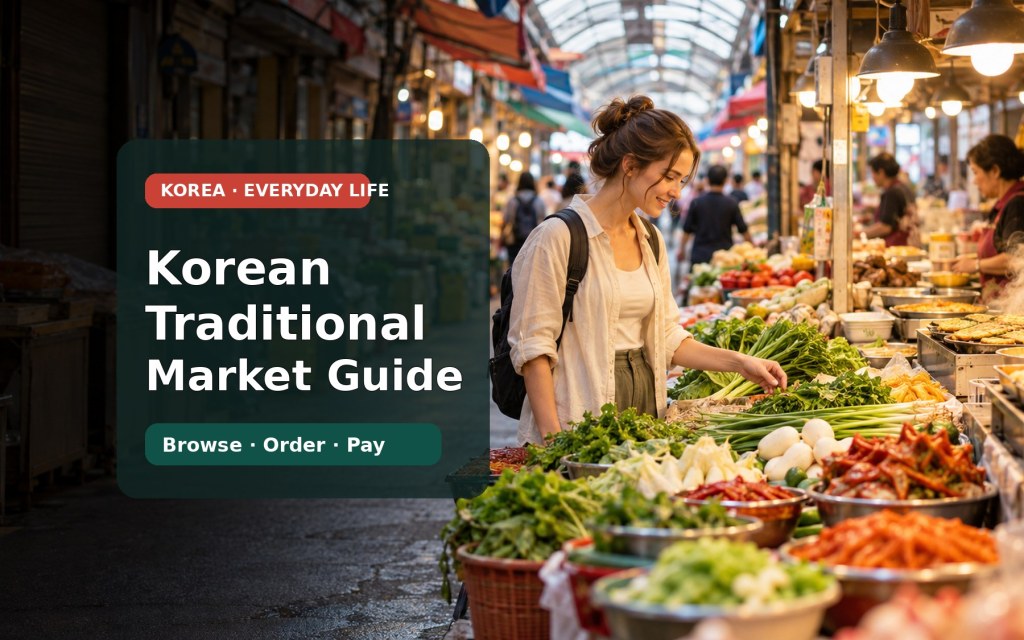
Planning your first Korean traditional market visit? Choose a market that fits your route, check its current hours, walk through once before buying, and ask each stall about the price, portion, and payment method. Markets are made up of different vendors, so one stall’s rules may not apply to the next.
A traditional market is a practical way to see local shopping and food culture in Korea. The Korea Tourism Organization (KTO) describes markets as places where visitors can experience local lifestyle, food, and culture. Here is a simple plan that helps you enjoy the atmosphere without guessing how every stall works.
1. Choose a market that fits your day
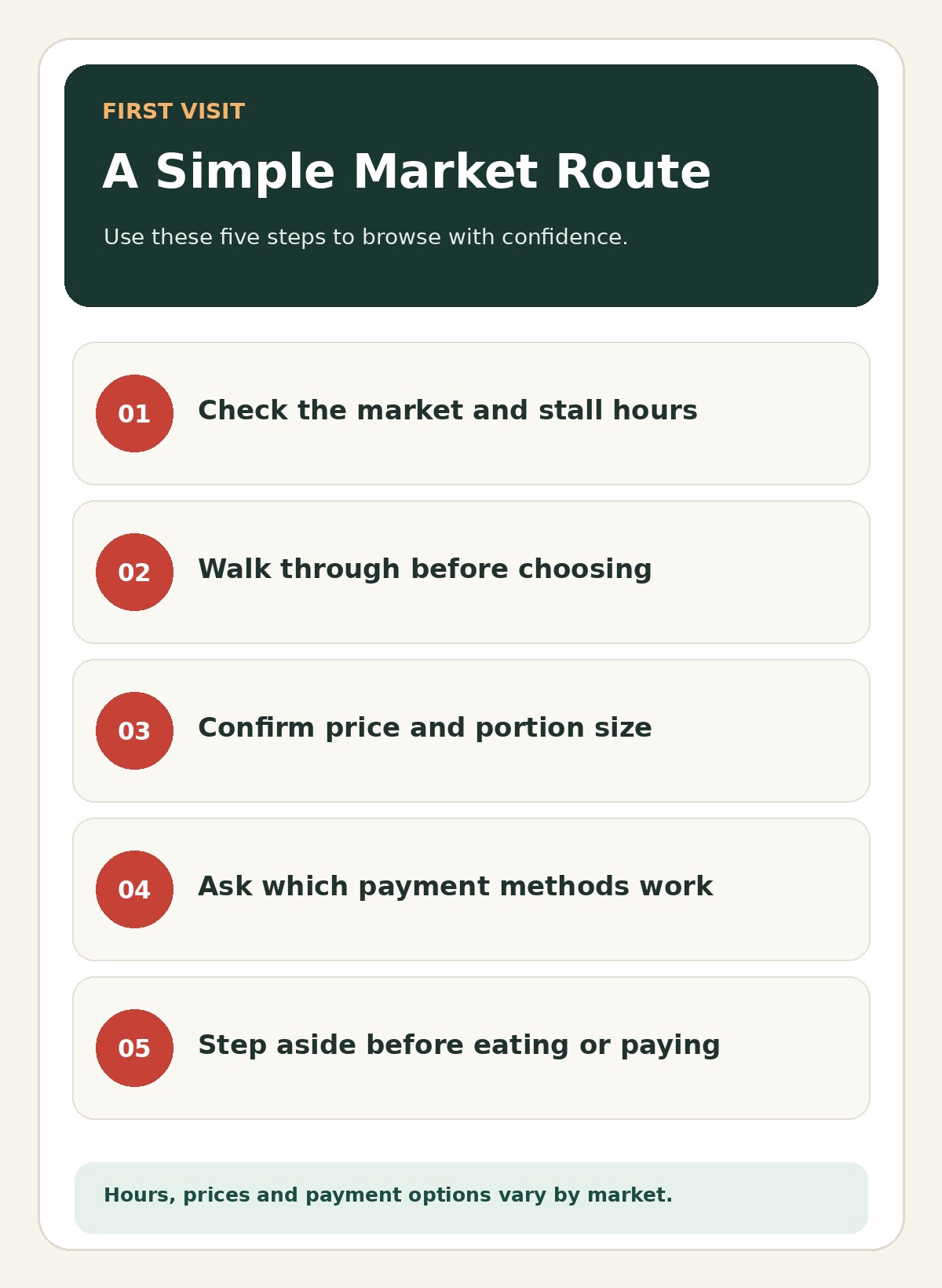
Start with the KTO’s Traditional Markets guide and check which market is near your sightseeing route. Its current K-Tourism Markets list includes places such as Mangwon and Gyeongdong markets in Seoul, Haeundae Market in Busan, and Dongmun Traditional Market on Jeju Island. Think about what you want to browse—local produce, household goods, clothing, or food—before you go.
Check the market’s official page for opening hours, holidays, and special areas on the day you plan to visit. Hours can differ within one market: for example, the KTO listing for Gwangjang Market gives separate hours for its general shops and food street. A market-wide label is not a guarantee that every individual stall will be open.
2. Walk through once before you choose
When you arrive, take a short loop through the main aisle before deciding what to buy. This gives you a chance to compare menus, portions, and prices, and to see where customers are lining up or eating. Keep doorways and busy walkways clear, especially when stopping to take a photo or check a map.
3. Confirm the price, portion, and payment method
Before ordering, point to the item and ask how much it costs and how much you will receive. If you are unsure whether a posted price is for one piece, one serving, or a set, ask before the vendor starts preparing it. You can use a translation app to show a short question, or try these phrases:
- 이거 얼마예요? — How much is this?
- 이거 하나 주세요. — One of these, please.
- 카드 돼요? — Can I pay by card?
- 포장해 주세요. — Please pack this to go.
Do not assume every stall accepts the same payment method. In May 2026, the Ministry of Culture, Sports and Tourism and the KTO announced a service-improvement campaign with eleven participating traditional markets. Its measures include fixed pricing and card-payment acceptance at those participating markets. That campaign applies to the named participants; it is not a promise about every market or vendor in Korea. Carry a backup payment option and ask first if a card is important to you.
4. Eat comfortably and respectfully
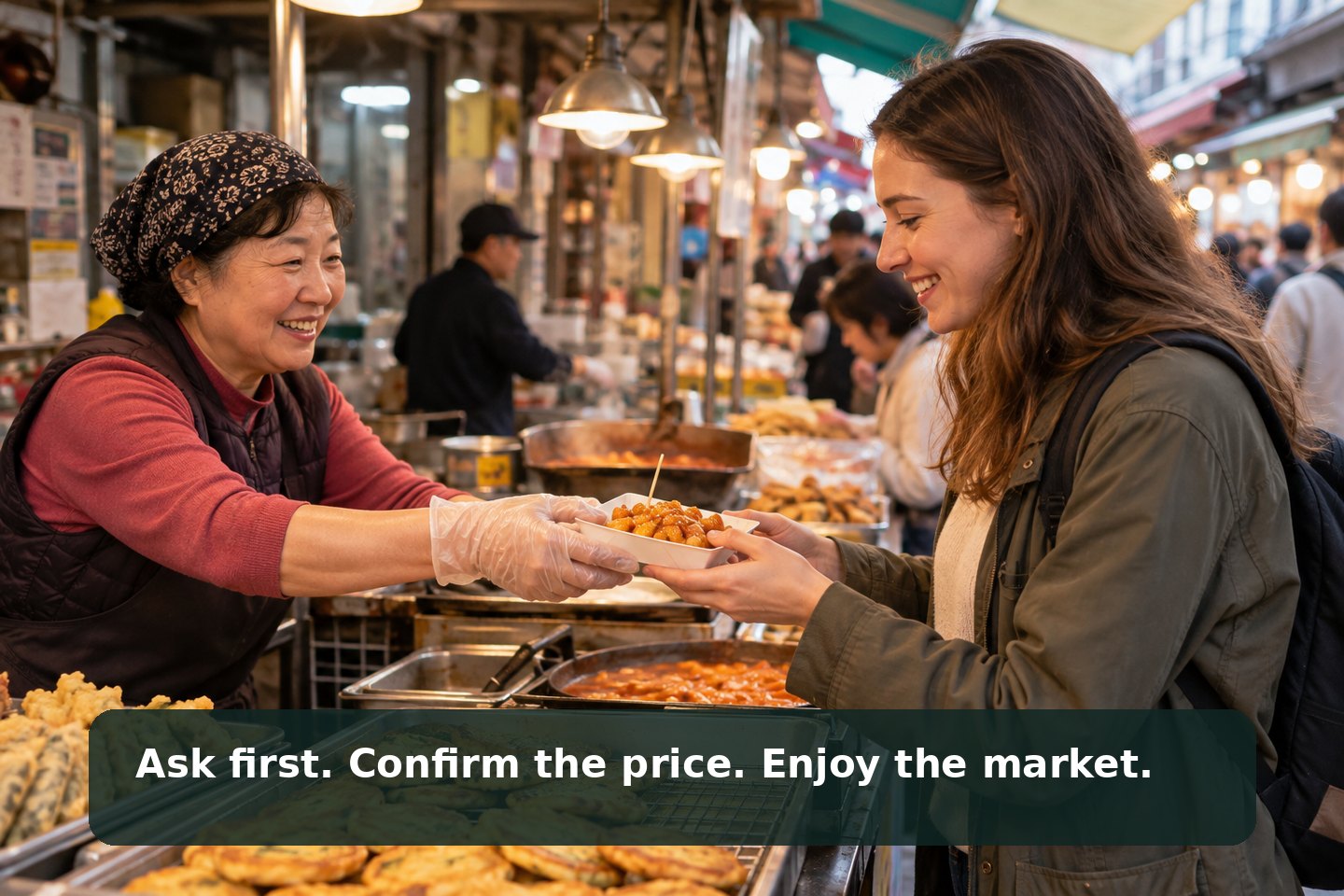
Some stalls have stools or a shared counter; others are designed for takeout. Look for signs or ask before sitting down. If the area is crowded, step away from the counter after paying so the next customer can order. Follow the vendor’s directions for trays, utensils, and waste.
If you have a food allergy or strict dietary requirement, ask about ingredients before ordering. A translated menu may not show every ingredient or shared cooking surface. If the vendor cannot confirm what is in the food, choose something else rather than relying on a guess. When photographing a vendor or another customer, ask first and respect a “no.”
A quick first-visit checklist
- Check the market’s official hours and holiday notice.
- Walk through before choosing a stall.
- Confirm the price, portion, and payment method before ordering.
- Keep a backup way to pay.
- Ask about ingredients when you have a dietary restriction.
- Keep aisles clear and follow the vendor’s instructions.
Frequently asked questions
Do I need cash at a Korean traditional market?
Not necessarily, but payment options differ by market and stall. Some KTO campaign markets have introduced card acceptance, while that should not be assumed everywhere. Ask before ordering and keep a backup option.
Can I visit a market in the evening?
Some markets have evening or night-market areas, but schedules differ. Check the official market listing before you go. The KTO’s Gwangjang Market listing, for example, shows different hours for shops and its food street.
What if I do not speak Korean?
Show the item you want, use a translation app for a short question, and confirm the price before ordering. These simple phrases can help: “이거 얼마예요?” (How much is this?) and “카드 돼요?” (Can I pay by card?).
Make your first market visit simple
Pick one market, check its schedule, and give yourself time to browse before choosing a stall. Confirming the price and payment method makes the visit easier, while leaving space for the next customer keeps busy aisles moving. If you would rather have a sit-down meal, see our first Korean restaurant guide. For a quick packaged meal between stops, read our convenience store guide for visitors.
Official references
- Korea Tourism Organization: Traditional Markets
- Korea Tourism Organization: Experience Friendly Service at K-Tourism and Traditional Korean Markets (May 28, 2026)
- Korea Tourism Organization: Gwangjang Market visitor information
Information checked October 8, 2026. Market hours, holidays, vendors, prices, facilities, and payment options vary. Check the official listing for the market you plan to visit.


Leave a comment