

Updated October 9, 2026. Flying into South Korea for the first time? The part that feels complicated is often not the flight itself. It is the arrival forms, finding your checked suitcase, clearing border procedures and making one good transport decision before you are tired. This independent, English-language guide gives you an actionable order of steps for Incheon International Airport (ICN), plus official places to verify rules that may change.
On this page · 13 practical sections
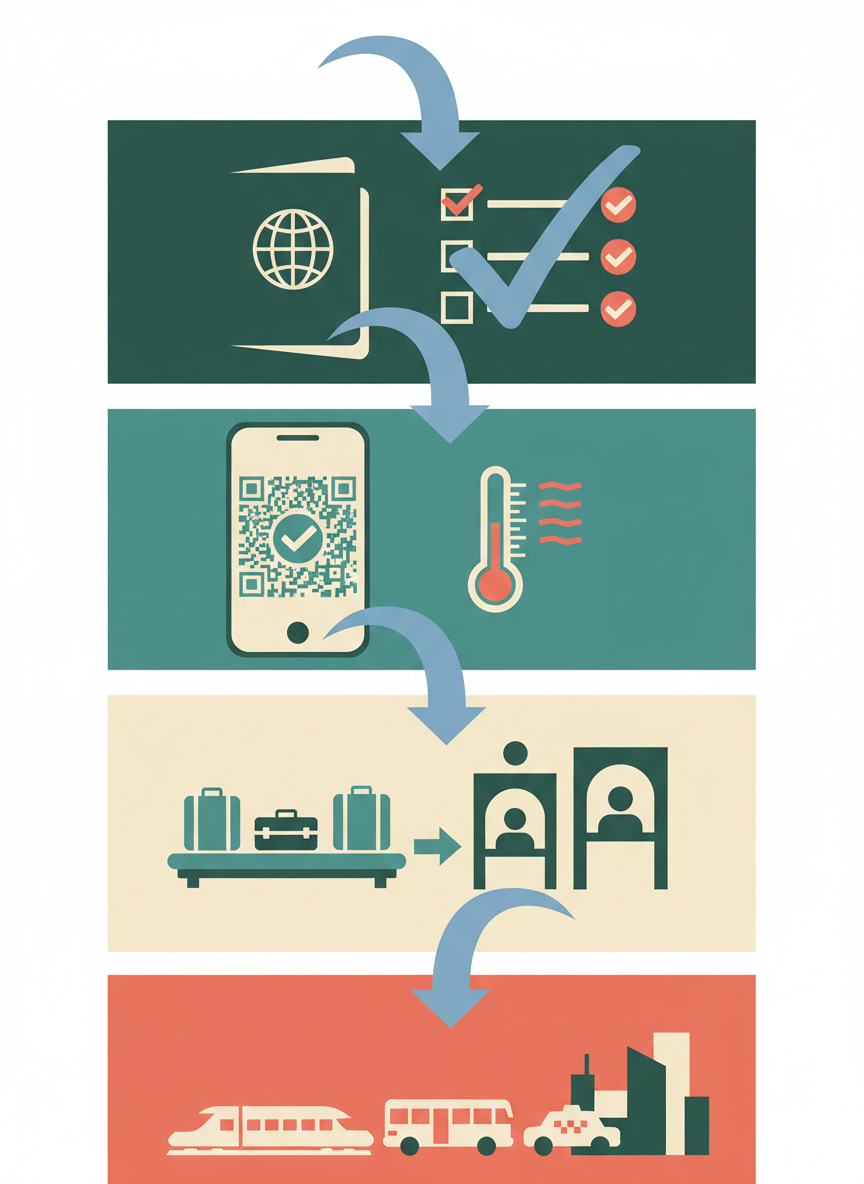
- Your 30-second arrival checklist
- Step 1 — Check which entry document applies to you
- Step 2 — Use the free e-Arrival Card when required
- Step 3 — Know whether Q-CODE applies to you
- Step 4 — Follow the airport’s actual arrival sequence
- Step 5 — Be careful with customs and declarations
- Step 6 — Identify your actual terminal before arranging pickup
- Step 7 — Pick the right ride to Seoul
- The first-hour travel kit: what to keep accessible
- Three common mistakes to avoid
- Simple Korean phrases for arrival
- Frequently asked questions
- Official sources and editorial standards
The essential distinction
K-ETA concerns certain travelers’ advance travel authorization. e-Arrival Card is an electronic entry declaration for people who need to submit it. Q-CODE concerns health/quarantine declarations for certain travel histories or symptoms. These are different systems. You might need one, more than one, or none of them depending on your circumstances. An arrival card is not a visa.
Your 30-second arrival checklist
- Before departure: confirm your own passport, visa or K-ETA status using an official government site, not a social-media checklist.
- Within three days before arrival, if required: complete the free e-Arrival Card at the official government website.
- If applicable: review health declaration obligations and Q-CODE using the Korea Disease Control and Prevention Agency (KDCA).
- At Incheon: follow the airport’s signposted sequence for any required quarantine screening, immigration, baggage collection and customs.
- Outside the secure area: check your actual terminal and choose transport according to your destination, arrival time and luggage.
Step 1 — Check which entry document applies to you
Entry requirements depend on your citizenship, passport, reason for travel, visa, residence status, previous K-ETA approval, age and changing exemption policies. Before paying for anything, consult the official K-ETA website and the official Korean immigration guidance for your situation. A valid e-Arrival Card does not by itself authorize entry or replace a visa.
The official K-ETA portal posts exemption notices and application instructions. Its notice extends temporary exemptions for eligible nationalities through December 31, 2026, not necessarily every visitor or every year. Do not assume the exemption will continue into 2027 or that every passport is covered.
If you already have valid K-ETA or a Korean residence card, that can change whether you must submit the e-Arrival Card. The official e-Arrival Card eligibility page is more reliable than guessing based on nationality alone.
Step 2 — Use the free e-Arrival Card when required
The only official e-Arrival Card service is e-arrivalcard.go.kr. The Korean government states that the e-Arrival Card is free and can be completed online within three days before arrival. It requests information such as passport details and your travel/arrival itinerary. Carefully check your passport spelling and local stay address before submitting.
Avoid paid imitation sites
The official immigration website explicitly warns about fake e-Arrival Card services that request payment information. For the entry declaration itself, do not pay. Type e-arrivalcard.go.kr directly and confirm the domain before entering personal information.
The official eligibility guide lists who is subject to the declaration and who is exempt. It specifically includes a K-ETA-exempt visitor among potential declarants and lists valid K-ETA holders among excluded travelers. Important exception: the official eligibility guide states that someone who holds K-ETA but is entering with a visa must still complete the e-Arrival Card. Use the on-site eligibility navigator for your exact entry status. Save your submission reference privately; official officers determine the actual entry process.
Step 3 — Know whether Q-CODE applies to you
Q-CODE is a separate health and quarantine information system administered by the Korea Disease Control and Prevention Agency. It is not universally required of every incoming traveler. Whether you need it depends on which countries or designated regions you have visited or transited through, and in some cases whether you have symptoms such as fever or cough.
KDCA explains that travelers from strict quarantine inspection required areas are subject to health declaration requirements; travelers from other designated quarantine management areas may be required to declare if they have relevant symptoms. Consult the current KDCA Q-CODE English guide and KDCA quarantine criteria because the area lists can change by quarter.
Current official update: October–December 2026
KDCA’s fourth-quarter 2026 quarantine area designations took effect on October 1, 2026. Anyone who stayed in or transited through a strict quarantine inspection required area must follow the health declaration rules. People who visited a broader quarantine inspection required area may have declaration obligations when relevant symptoms are present. These two lists have different criteria and are periodically revised; they are not a blanket Q-CODE requirement for all international flights.
Important for U.S. visitors: KDCA’s published October–December 2026 list names New Mexico, Michigan and Washington State as specific U.S. areas in its strict quarantine inspection required category. Under that category, travelers who visited or transited through a listed region must submit a Q-CODE or Health Declaration Form, regardless of symptoms. This is not a rule covering every U.S. state, and the lists can change. Refer to page 2 of KDCA’s official fourth-quarter document and check the latest guidance for your entire itinerary.
Verify your complete itinerary using the official KDCA fourth-quarter 2026 English guidance (PDF) and the current Q-CODE information page immediately before traveling.
If you are required to use Q-CODE, the official system allows pre-entry submission starting seven days before arrival. The system generates a QR code you can save for inspection. The health declaration may also be handled at arrival according to KDCA instructions; do not assume a missing QR code means you will be denied entry.
Step 4 — Follow the airport’s actual arrival sequence
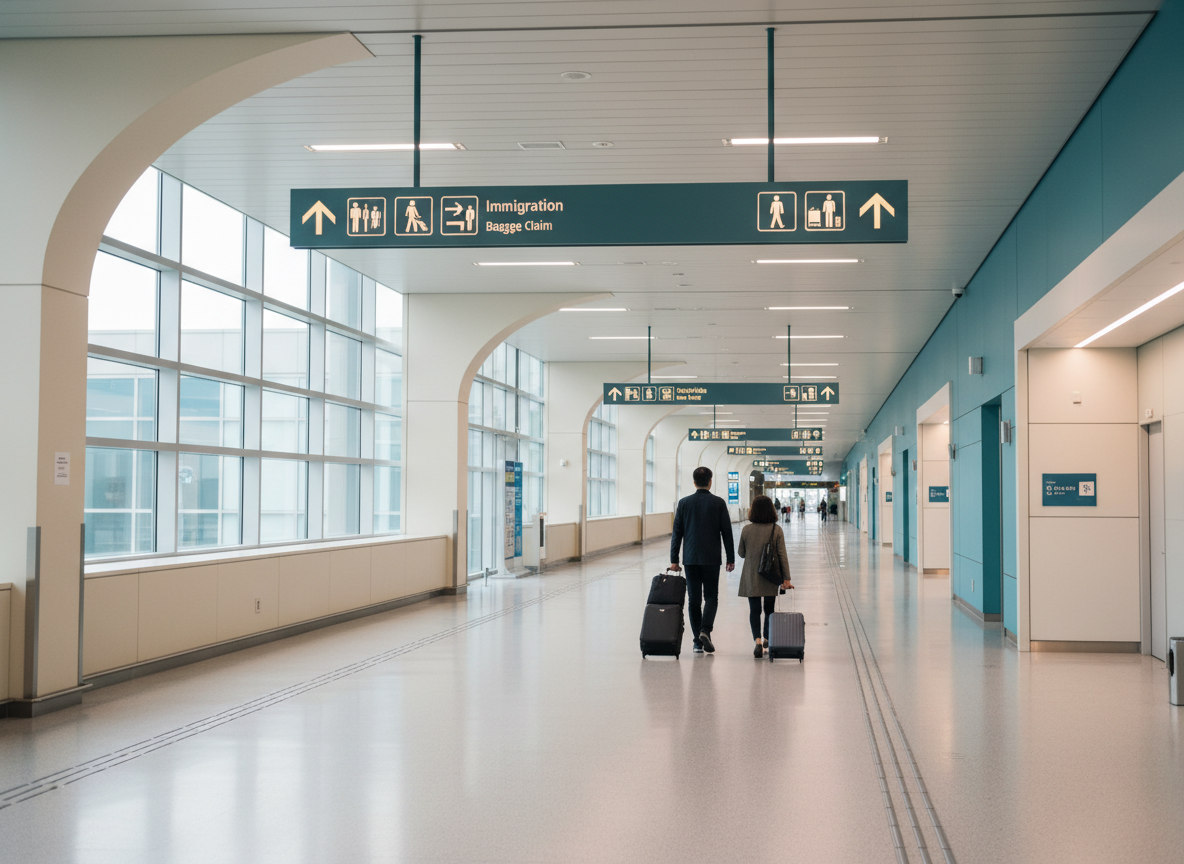
Incheon International Airport’s official arrival procedure lays out the main journey: arrival at the terminal or concourse, any necessary declaration/quarantine information, immigration, baggage claim, and exit into the arrival hall. Airport signage and border officers take priority over a static travel blog. The actual order of a particular screening or customs step can differ based on the flight and inspection needs.
- Arrive and follow “Arrivals/Immigration” signs. If you arrive at the satellite concourse, the airport may direct you to a shuttle train to the main terminal.
- Go through immigration. Keep your passport and relevant entry/authorization details accessible. Follow the lanes and officer directions applicable to your status.
- Find your baggage carousel. Verify the flight number and baggage-claim number on the monitors after immigration.
- Follow customs instructions. Declare goods if required. Do not assume being a tourist means there are no declaration obligations.
- Exit into the public arrival hall. Check your terminal, meeting point, local connectivity and onward transportation before leaving the airport.
Step 5 — Be careful with customs and declarations
Customs rules are separate from immigration and health screening. Korea Customs Service provides official information about passenger customs clearance and items that must be declared. If carrying goods subject to declarations, follow the current airport instructions and make an accurate declaration. A “Nothing to Declare” lane is not permission to conceal restricted or taxable items.
Because exemptions, thresholds and import restrictions can change and differ by product, this guide does not guess current duty-free allowances or promise that specific food, medicine or animal products are permitted. Check the responsible customs and quarantine authorities before packing unfamiliar items.
Step 6 — Identify your actual terminal before arranging pickup
Incheon Airport has multiple passenger terminals and a concourse. Terminal assignments depend on airlines, flights and codeshare arrangements. The airport explicitly tells passengers to verify the terminal on their ticket or its flight information system. Never book a pickup based only on the airline’s usual terminal.
- Save the flight number and arrival date, including any date change across time zones.
- Send the driver or host a flight number and confirm their specific meeting zone after customs.
- If you are being met, agree on an accessible public-area meeting point and a backup contact method.
- If connecting to another domestic or international flight, follow the airport’s transfer instructions—do not assume you must exit into the public arrivals area.
Step 7 — Pick the right ride to Seoul
Before you leave the airport, check your mobile connection. A working map, hotel message or translation app can make your first hour easier. Our Korea eSIM vs SIM vs pocket Wi-Fi guide → explains compatibility, plans and airport setup without relying on unverified price claims.
Your choice after arrival should reflect your destination, the time, and how much luggage you can comfortably move. Trains, buses and taxis serve different travelers. No option is best for everyone, and services or first/last departures can change.
| Option | Often a good fit for | Check before buying |
|---|---|---|
| Airport railway | A traveler heading toward a convenient railway connection with manageable luggage | Express vs all-stop service, destination, transfers, late-night hours and exact fare |
| Airport limousine bus | A hotel or neighborhood near a direct bus stop and a traveler with heavier luggage | Route number, stop location, luggage rules, timetable and ticket method |
| Official taxi stand | Late arrival, several travelers or door-to-door needs | Recognized pickup location, traffic, tolls, metered fare and payment |
For Seoul-city transport once you arrive, use our Tmoney, Climate Card and subway guide. For a layover with a suitcase, see our Seoul luggage storage guide. Those guides explain city options; always verify airport-specific route availability separately.
The first-hour travel kit: what to keep accessible
- Passport and applicable entry document confirmation; keep personally identifiable documents private.
- Hotel name, Korean-language address and check-in or meeting details saved offline.
- Airline flight number and baggage claim tag.
- A charged phone, suitable charger and a safe connection method; airport Wi-Fi availability should be checked on arrival.
- One payment backup, such as a second accepted card or accessible cash, without assuming every vending machine accepts foreign cards.
- An offline map screenshot of the specific station, bus stop or hotel entrance.
- Emergency number 112 (police) and 119 (fire/rescue/ambulance); tourism information 1330.
Three common mistakes to avoid
Mistake 1: Paying for the free e-Arrival Card. The official Korean government service is free. Verify the exact government domain before submitting passport data.
Mistake 2: Treating Q-CODE as a visa or always-required form. It is a health declaration process for designated circumstances. Check the KDCA’s current country/region and symptom criteria.
Mistake 3: Assuming every foreign traveler has the same K-ETA status. Exemptions are nationality- and situation-dependent, and notices have end dates. Check official Korean immigration guidance before flying.
Simple Korean phrases for arrival
| Phrase | What it means |
|---|---|
| 입국 심사 어디예요? | Where is immigration? |
| 수하물 찾는 곳 어디예요? | Where is baggage claim? |
| 공항철도 어디예요? | Where is the airport railway? |
| 이 버스 서울역 가요? | Does this bus go to Seoul Station? |
| 영어로 안내해 주실 수 있나요? | Could you help me in English? |
You can show the Korean sentence on your phone rather than trying to pronounce it. For itinerary questions and language support, the Korea Tourism Organization operates the 1330 Travel Helpline. Emergency services are separate.
Frequently asked questions
Is the Korean e-Arrival Card always required?
No. The official declaration page identifies included and excluded groups. Your K-ETA, visa and residence status can affect eligibility. Use the government navigator, rather than assuming all foreign passports have the same requirement.
Does the e-Arrival Card cost anything?
No. The official e-Arrival Card declaration is free. Payment requests are a strong reason to stop and confirm you are on the correct government domain.
Do all arrivals need Q-CODE?
No. KDCA’s public criteria target certain travel histories or designated management areas and, in some situations, symptoms. The lists are periodically updated.
Do I need a Korean transit card before leaving the airport?
Not necessarily. It depends on the transport service you choose. Check the ticketing and payment information for your specific train, bus or taxi. Do not assume one card works for every transport product.
Official sources and editorial standards
Reviewed October 9, 2026. Primary references: Incheon Airport — Arrival Procedures; Republic of Korea — e-Arrival Card official website; e-Arrival Card eligibility guide; K-ETA official government portal; KDCA Q-CODE English guide; Korea Customs Service — Arriving Travelers.
Editorial boundary: This is an independent researched travel-planning article, not an official immigration, airline, medical or legal service and not a first-person account of testing every airport procedure. Passport/visa permissions, health requirements and customs obligations can change. Use the government websites for your specific journey and follow officers’ directions at the airport.
Keep reading: Start Here · Official Korea Travel Resources · Seoul transport guide.

Leave a Reply