
Updated October 9, 2026. If your hotel check-in is hours away, carrying a suitcase around Seoul is exhausting. The useful question is not simply “Are there lockers?” It is which kind of storage can hold your bag, what will it cost, and can you collect it before the service closes? Seoul’s official city website describes several options that sound similar but work very differently.
On this page · 12 practical sections
- At a glance: which Seoul storage service should you use?
- Step 1 — Decide whether you need a person or a locker
- Step 2 — Know where to look
- Step 3 — Compare actual costs before tapping ‘Pay’
- Step 4 — Fit, payment and language: three checks that prevent trouble
- Step 5 — Make your collection plan before sightseeing
- What should you not leave in storage?
- Scenario: four hours between hotel checkout and your train
- Useful Korean words when you cannot find the storage desk
- Frequently asked questions
- Official source and update note
- Plan the rest of your visit
Quick choice: staffed luggage service vs self-service locker
Use T-Luggage when you have a suitcase and want a staffed luggage-storage or delivery service. Use T-Locker when a suitably sized self-service locker is available at your station. T-Storage is intended for longer, usually monthly storage—not the normal choice for a few tourist hours.
At a glance: which Seoul storage service should you use?
| Service | Best for | Important difference |
|---|---|---|
| T-Luggage | Suitcase for several hours; some delivery routes | Service locations and desk hours are limited; storage and delivery cost differently |
| T-Locker | A backpack or suitcase fitting a station locker | Self-service; locker availability, size, location and retrieval hours matter |
| T-Storage | Longer-term belongings storage | Monthly rental; not an hourly suitcase locker |
These names are easy to confuse. The city’s official Subway Storage Facilities page describes all three. Check that source again immediately before you travel, especially for fees, locations and operating hours.
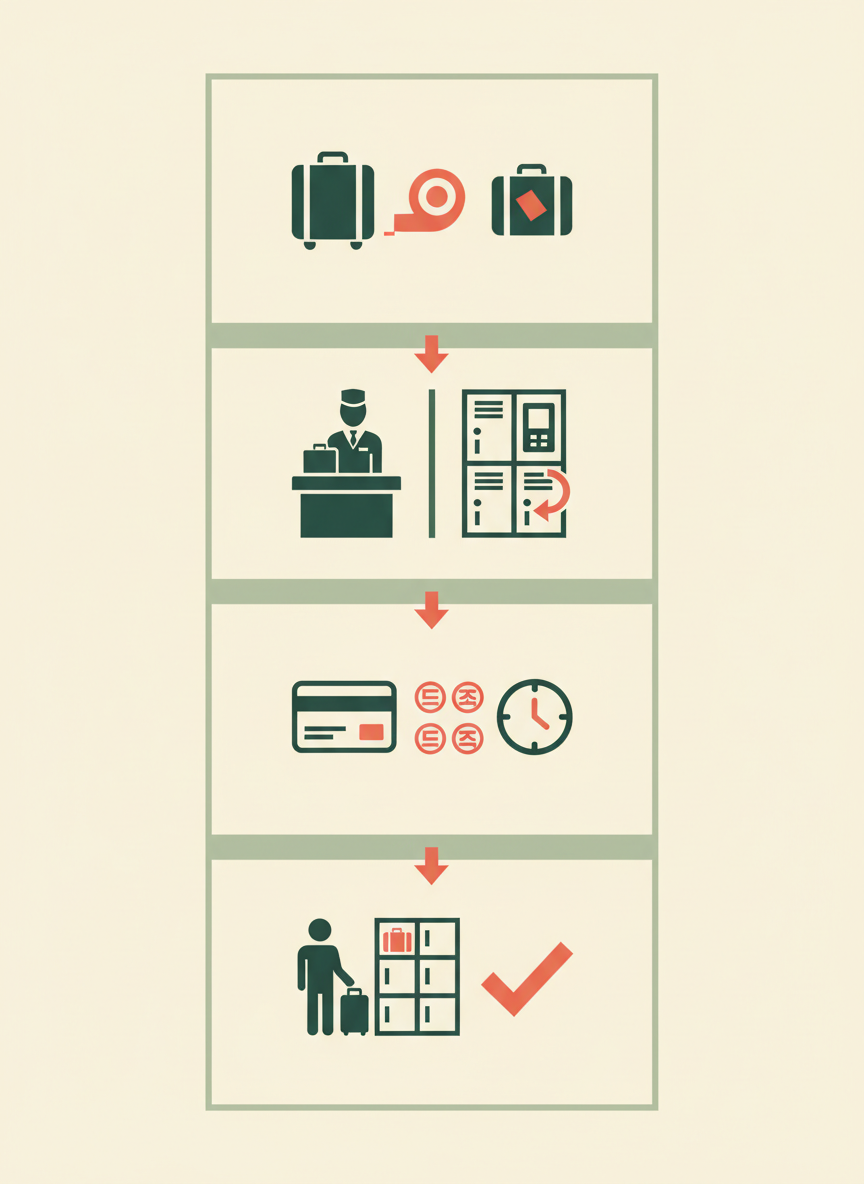
Step 1 — Decide whether you need a person or a locker
Choose T-Luggage if you would rather hand a suitcase to a staffed counter. The city lists storage and same-day delivery options, but check whether your exact station, destination and bag are accepted. Same-day delivery is a separate service and should not be assumed to be included in the basic storage fee.
Choose T-Locker if you can handle a self-service machine or app, and your bag fits the stated locker dimensions. T-Locker is more widely distributed than T-Luggage, but a station having lockers does not mean one will be empty when you arrive.
Skip T-Storage for short visits: it is a monthly storage service designed for larger items or longer periods. Its pricing and terms are different from hourly lockers.
Step 2 — Know where to look
For T-Luggage, the Seoul Metropolitan Government currently lists the following reference service points. They are not a guarantee of today’s availability or an exhaustive list of other private storage providers:
- Seoul Station: basement level 1 near Exit 1.
- Hongik University Station: basement level 1 near Exits 3 and 4.
- Jamsil Station: basement level 1 near Exits 3 and 4.
- Myeong-dong Station: basement level 1 near Exits 9 and 10.
- Gimpo International Airport Station: basement level 1 near the information center.
- Jongno 3(sam)-ga Station: basement level 1 near Exit 6.
For T-Locker, choose the station that works with your next trip, and confirm the current unit location and size using the posted signage or applicable service instructions. Carrying a suitcase to the wrong side of a large interchange can defeat the purpose of storage.
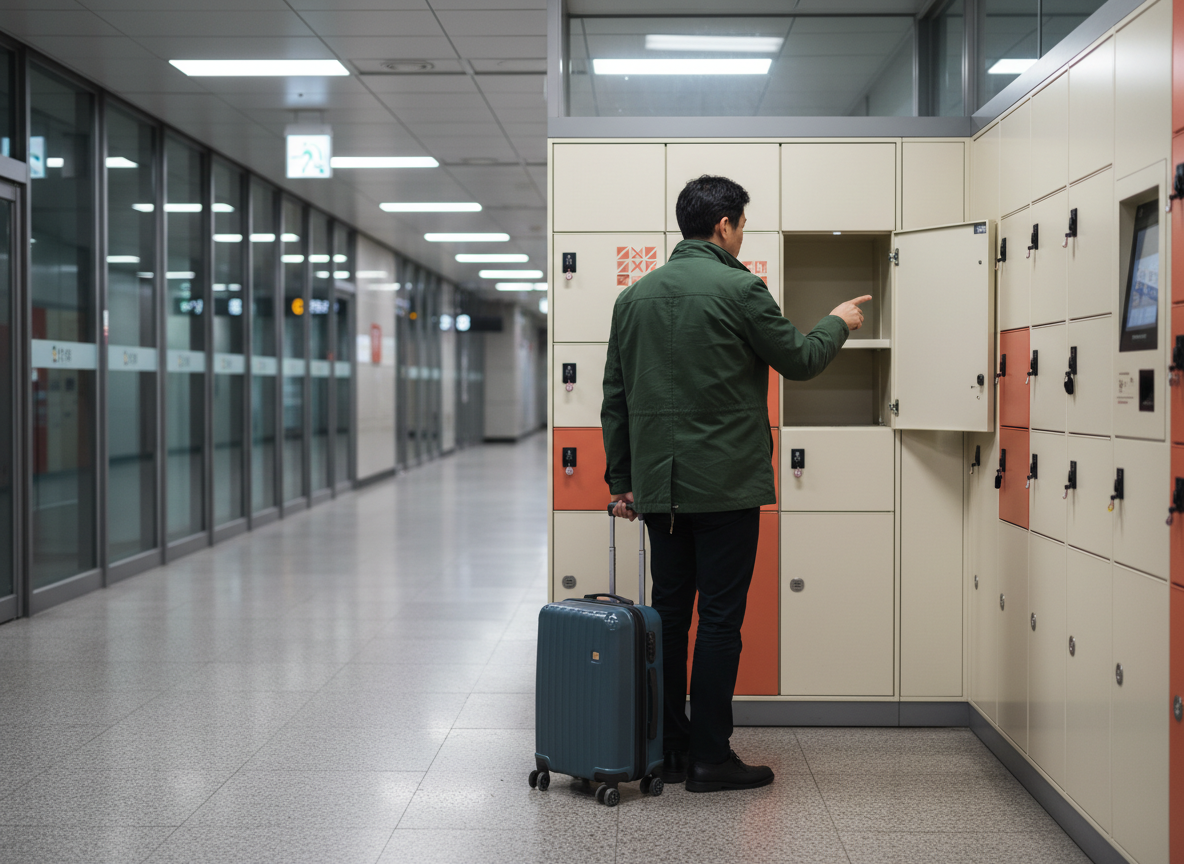
Step 3 — Compare actual costs before tapping ‘Pay’
The city page lists these reference T-Locker base prices for the first four hours. The posted rate at your exact locker is the final authority:
| Locker size | Weekday (first 4 h) | Weekend (first 4 h) | Extra / hour |
|---|---|---|---|
| Small | ₩2,200 | ₩3,100 | ₩500 |
| Medium | ₩3,300 | ₩4,600 | ₩800 |
| Large | ₩4,400 | ₩6,100 | ₩1,000 |
Worked example: if an eligible small weekday locker costs ₩2,200 for four hours and ₩500 per extra hour, six billable hours would cost ₩3,200 under that schedule. This is an illustration, not a quoted price or guarantee that the locker is available.
T-Luggage is a different service: the same city page lists a four-hour weekday starting price of ₩3,000 for a small bag and more for larger bags, with weekend supplements and hourly additions. Large suitcases may be more suitable there, but do not compare its costs with T-Locker without checking luggage size definitions and collection hours.
Step 4 — Fit, payment and language: three checks that prevent trouble
- Measure first. A locker’s stated size describes the interior space—not the label on your suitcase. Account for protruding wheels and handles; do not force a large case into a smaller unit.
- Check payment on screen before storing. App availability, supported cards and identity requirements may vary. Do not assume every locker or staffed desk accepts a foreign credit card; check the available payment options first.
- Keep the retrieval instructions. Save your QR code or access details, take a picture of the locker number and station exit (not of personal access codes publicly), and confirm the retrieval deadline before you leave.
Step 5 — Make your collection plan before sightseeing
The Seoul Metropolitan Government lists T-Luggage staffed service at 9:00 a.m.–10:00 p.m. and T-Locker storage and retrieval at 5:00 a.m.–12:00 midnight (daily). These are separate services with different access hours, so a self-service locker is not a guarantee of 24-hour access. Confirm the specific station and service before paying because schedules, maintenance and operating rules can change.
A small plan that avoids a missed pickup
Before leaving your suitcase: (1) pin the exact station and exit on your map, (2) save the locker or service receipt privately, (3) set a reminder well before closing, (4) allow time for platform transfers and station exits, and (5) keep your passport and essential medicine with you rather than in unattended storage.
What should you not leave in storage?
Avoid using a locker or temporary counter as your main security plan for high-value valuables, passports, essential medication or anything you cannot afford to lose. Service terms and prohibited items vary. Seoul’s listed long-term T-Storage conditions explicitly exclude valuables, hazardous materials, some medicines and other categories; temporary services may have their own lists. Read the operator’s current terms at the point of use.
Scenario: four hours between hotel checkout and your train
Imagine that your hotel checkout is at 11 a.m., and your train leaves Seoul Station at 5:30 p.m. You want lunch without dragging a case. First, check whether your hotel can hold luggage at no charge: many accommodation providers offer this but it depends on the property. If not, confirm the closest available locker or T-Luggage service, bag fit and payment options. Plan a return to the station with a generous buffer before departure.
The best option is not necessarily the cheapest on paper. If a locker costs less but is on the wrong side of the city, a convenient staffed location or hotel storage may save more time.
Useful Korean words when you cannot find the storage desk
| Korean phrase | English meaning |
|---|---|
| 물품보관함 (mulpum bogwanham) | Luggage/storage locker |
| 짐 보관 (jim bogwan) | Luggage storage |
| 어디에 있어요? (eodie isseoyo?) | Where is it? |
| 몇 시까지예요? (myeot si-kkajiyeyo?) | Until what time? |
| 카드 결제 돼요? (kadeu gyeolje dwaeyo?) | Can I pay by card? |
Try showing a simple typed phrase to station staff: “물품보관함 어디에 있어요?” (“Where are the luggage lockers?”). Keep a screenshot handy if you do not have data coverage.
Frequently asked questions
Are lockers available in every Seoul subway station?
No universal availability should be assumed. The city lists a large T-Locker network, but actual locations, sizes and vacancies depend on the station and the time you visit.
Can I store my luggage overnight?
Do not assume overnight access. A storage service may charge after its basic rental period or limit pickup outside operating hours. Check the exact overnight policy and opening times before paying.
Are T-Luggage and T-Locker the same service?
No. T-Luggage refers to staffed luggage storage or delivery services at listed locations. T-Locker refers to self-service lockers, with prices and access procedures based on the locker facility.
What if the payment screen is only in Korean?
Ask station staff or the operator for assistance, look for language controls, or choose a staffed alternative. Avoid guessing through payment steps or submitting sensitive personal information to an unfamiliar third-party website.
Official source and update note
Seoul Metropolitan Government — Subway Storage Facilities (official English site). This is the primary source for the service distinctions, location examples, size categories, reference prices and hours in this guide. Accessed October 9, 2026. Availability, prices, payment acceptance and service terms must be confirmed at the service point when you travel.
This article is an independent English-language planning guide based on published public information, not a firsthand service review. It is not affiliated with Seoul Metro or any locker operator.
Plan the rest of your visit
Once your luggage is sorted, our Seoul public transport guide explains how to compare transit payment choices. Planning lunch? See our first Korean restaurant walkthrough, or explore Start Here for all essential guides.
Flying into Korea for the first time?
Before you travel around Seoul, check the free government e-Arrival Card, K-ETA eligibility, Q-CODE health rules and Incheon immigration and baggage procedures in our Incheon Airport arrival checklist for 2026 →. Use official services to confirm rules for your passport and itinerary.
Need help while traveling in Korea?
For non-emergency tourist information and language assistance, Korea’s 1330 helpline can be useful. For immediate danger or urgent emergencies, contact 112 (police) or 119 (fire and ambulance). Read the 1330 travel help guide →


Leave a Reply